




At Rutland Square Spirits, every bottle tells a story inspired by ancestral heritage and craftsmanship. Nishant Sharma, CEO and Founder, pours a glass and shares more about the unique intersection of two powerful cultures that the company sits at the centre of.
SCOTTISH SPIRIT; INDIAN SOUL
“I am Indian by birth and heritage, Scottish by life. Chai – or tea – is ritual in India; it represents comfort, conversation, and daily ceremony. I began asking a simple question: why has no one translated authentic chai culture into a serious, premium global spirits proposition?”
This question, posed by Nishant Sharma, CEO and Founder, resulted in Rutland Square Spirits (Rutland Square) – a bridge between his past and present.
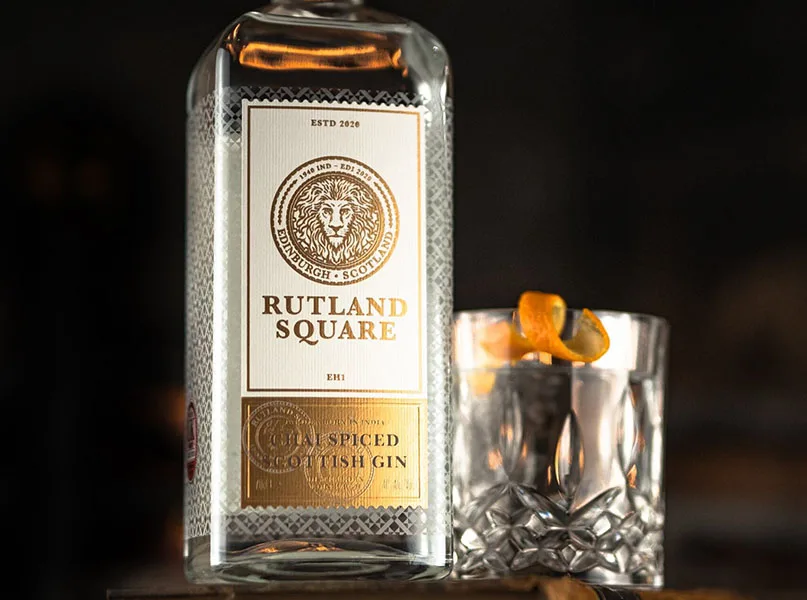
As a premium spirits company building a new global flavour category, Chai-Spiced Scottish Spirits, Rutland Square is combining Scottish production discipline with Indian flavour heritage.
Its current portfolio includes Chai-Spiced Scottish Gin and Chai-Spiced Scottish Rum, and each product is positioned at the premium end of the market, built around authenticity, provenance, and global scalability.
“We operate across hospitality, retail, and international distribution, with a presence in the UK, India, Canada, and the Middle East. From the beginning, our infrastructure has been designed for global expansion rather than domestic craft growth,” details Sharma.
Today, Rutland Square operates with a multi-market team across the UK, India, and the Middle East, supported by production, logistics, and distribution partners. Its long-term ambition is to build an internationally recognised, flavour-led spirits house, not just a single-product brand.
“Rutland Square sits at the intersection of two powerful traditions. Scotland represents craftsmanship, regulatory rigour, and global credibility in spirits; India represents flavour complexity, warmth, and cultural ritual,” prides Sharma.
For the company, this is more than just a marketing construct – it is lived identity translated into product.
Rutland Square’s liquids are produced to Scottish standards to ensure quality and consistency, whilst the flavour architecture is rooted in authentic chai culture – featuring layered spice, warmth, and aromatic balance.
“In India and the Middle East, the flavour resonates culturally. In the UK and Western markets, it offers discovery and differentiation. That dual relevance gives the brand strategic flexibility,” he expands.

“Rutland Square sits at the intersection of two powerful traditions. Scotland represents craftsmanship, regulatory rigour, and global credibility in spirits; India represents flavour complexity, warmth, and cultural ritual”
Nishant Sharma, CEO and Founder, Rutland Square Spirits
BUILDING AN ENDURING BRAND
Having never followed a conventional path, Sharma’s career was shaped by curiosity, calculated risk, and a deep conviction to build something that endures – without a safety net to fall back on.
“I began as a dishwasher before waiting tables at Ashoka at the Mill in Darnley, Glasgow,” he shares.
“That environment taught me more about work ethic and consumer psychology than any corporate role – how people make choices, how atmosphere shapes experience, and how culture influences behaviour.”
From there, Sharma moved into selling insurance before progressing to financial services and later day-rate contracting, working with institutions including Scottish Widows, Aegon, HSBC, and BlackRock. This provided him with discipline and exposure to capital markets; however, Sharma felt that he was helping build someone else’s long-term asset rather than creating his own.
“Entrepreneurship, for me, is generational. I grew up hearing stories of my great-grandfather building substantial assets from nothing. What stayed with me was not the wealth, but the mindset – the belief that something lasting can be created through resilience and conviction,” he impassions.
Sharma’s entry into spirits was intentional, but not obvious. Scotland is synonymous with whisky, but he did not want to launch another brand into an already crowded category.
The breakthrough came when he reframed the question around identity and what that means at a personal level.
“From the outset, the goal was not novelty, but scalability rooted in culture,” he emphasises.
Global drinks trends showed increasing demand for authenticity, provenance, and premiumisation. Consumers wanted depth, not gimmicks, and Sharma recognised the opportunity to build something culturally grounded yet globally premium.

FLAVOUR THAT RESONATES CULTURALLY
Founded to unite cultures and craft exceptional spirits, Rutland Square differentiates itself from other drink brands in a variety of ways.
Specifically, through the company’s unique category creation, it is actively building a new flavour space rather than competing within an already existing one.
Equally, the brand’s authenticity speaks volumes. The use of chai is culturally grounded, not just a superficial flavour addition.
“We have had global intent from day one and are structured as a cross-border brand with institutional ambition. Ultimately, we are building a scalable flavour platform, not just a single stock keeping unit (SKU) story,” details Sharma.
A prime example of Rutland Square’s inventive flavour expansion is its Chai-Spiced Scottish Rum – aged in ex-sherry casks for a ruby-rich depth whilst marrying velvety molasses with first-flush Oolong white tea.
The rum features the aromatic warmth of chai spice as it offers a passport to uncharted flavour and can be sipped slowly to savour the blend of cultures as the Caribbean sun meets Assam’s mist.
“The launch of Chai-Spiced Scottish Rum marked a strategic evolution. Gin validated the concept; rum demonstrated scalability,” insights Sharma.
“Rum is one of the largest global spirits categories. Entering it signalled that we are building a portfolio business capable of extending flavour architecture across categories whilst maintaining brand cohesion.”

CLARIFYING PURPOSE WITH ADVERSITY
Currently, Rutland Square is exploring the development of a net zero distillery and hospitality destination in Midlothian, Edinburgh, which will combine production, visitor experience, and sustainability – all traits crucial to the company’s core.
“The ambition is to create a long-term physical home for the brand that integrates culture, craft, and environmental responsibility. A destination model deepens engagement and builds long-term brand equity,” expands Sharma.
Equally, as Rutland Squares continues to look towards a successful future, its focus is primarily on disciplined global scaling.
The company will achieve this by strengthening its international distribution, enhancing supply chain resilience, increasing visibility in priority markets, and driving towards sustained profitability, thus allowing it to build infrastructure for permanence rather than chasing short-term volume.
An important aspect for Sharma going forwards is the recognition that, whilst entrepreneurship is often romanticised, the reality is far more complex.
“There was a period where the business nearly cost me everything – financially and personally. A serious health scare forced me to reassess sustainability, both operational and personal,” he reveals.
However, Sharma found that through the adversity, his purpose was clarified.
“Rutland Square represents the belief that identity, culture, and persistence can create globally relevant brands. This has never been about alcohol alone; it is about building something that lasts,” he proudly concludes.
This article was produced by the editorial team at Food & Beverage Outlook and published as part of the Outlook Publishing global network of B2B industry magazines.
Outlook Publishing delivers industry insights, company stories, and sector coverage across food production, manufacturing, supply chains, construction, healthcare, mining, and sustainability.
Food & Beverage Outlook provides ongoing coverage of organisations and developments shaping the global food and beverage sector.